

Health & Science | Breaking Research – Karl Lionel, Senior Health Correspondent | Published Today
For the first time in decades, researchers believe they have identified not just a treatment for age-related joint pain — but a genuine biological solution to the root cause of it.
The findings, emerging from a convergence of independent clinical trials, peer-reviewed studies, and real-world patient data involving tens of thousands of participants, point to a specific molecular mechanism that drives joint deterioration in virtually every adult over 50 — and, critically, a way to reverse it.

The implications are significant. Joint pain, stiffness, and reduced mobility currently affect an estimated 58.5 million Americans, representing one of the largest and most undertreated health crises in the country.
Discover the Joint Genesis Protocol — See the Clinical Evidence Behind It →
It costs the United States healthcare system in excess of $300 billion annually in direct medical costs, lost productivity, and disability-related expenditure. For the individuals living with it, the cost is measured in something less quantifiable but no less real: the gradual erosion of independence, physical confidence, and quality of life.
For 30 years, the standard response to this crisis has been largely unchanged. Anti-inflammatory drugs. Glucosamine and chondroitin. Cortisone injections. Eventual surgical intervention. A management framework built around suppressing symptoms rather than addressing their origin.
What the new research suggests is that this framework has been targeting the wrong problem entirely.
The Discovery That Changes the Conversation
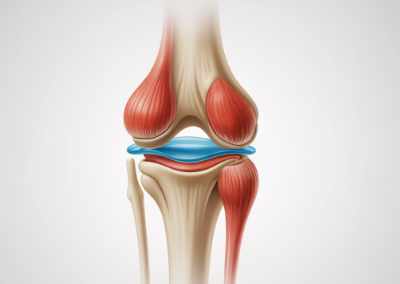
The breakthrough centres on a substance called hyaluronan — a long-chain sugar molecule found in the synovial fluid that surrounds every joint in the human body.
Synovial fluid is the joint’s primary defence system. It lubricates cartilage surfaces to prevent grinding, cushions impact, and — critically — serves as the sole nutritional delivery mechanism for cartilage, which has no direct blood supply of its own. Without healthy synovial fluid, cartilage is simultaneously unprotected and malnourished. Deterioration is not a question of if. It is a question of when.
Hyaluronan is the molecule that determines synovial fluid quality. In a young, healthy joint, hyaluronan molecules form a dense, viscous gel — creating the thick, protective fluid that makes effortless movement possible. The concentration of hyaluronan in the synovial fluid of a healthy 25-year-old is measurably different from that of a 60-year-old — not because of injury or disease, but because of a biological process that begins in the fourth decade of life and does not stop.
Research published across multiple peer-reviewed journals — including the Journal of Orthopaedic Research, Osteoarthritis and Cartilage, and Aging Clinical and Experimental Research — has now established a clear, reproducible pattern: hyaluronan production declines progressively from age 40 onward, with the rate of decline accelerating in the 50s and 60s. By the time most people are experiencing significant joint symptoms, their synovial fluid has lost a substantial proportion of the hyaluronan concentration it had two decades earlier.
This finding reframes the entire conversation about joint aging. The dominant narrative — that joint pain is the result of cartilage “wearing out” over time — is not wrong, but it is incomplete. Cartilage does not wear out in a vacuum. It wears out because the fluid designed to protect it has been silently degraded of the very molecule that gives it its protective properties.
The question that this raises — obvious in retrospect, but surprisingly underexplored until recently — is this: what happens if you restore hyaluronan?
Why No One Solved This Earlier
The short answer is that restoring hyaluronan is harder than it sounds.

Hyaluronic acid has been available as a medical treatment for decades. Doctors have been injecting it directly into knee joints — in a procedure called viscosupplementation — since the 1990s. The results have been mixed. Some patients experience meaningful short-term relief. Others see little benefit. The injections require clinical administration, carry a small risk of infection, and need to be repeated every several months. They are not a practical long-term solution for the majority of people experiencing age-related joint decline.
Oral hyaluronic acid supplements have been available for longer still. The problem is absorption. Standard oral hyaluronic acid products typically use low-molecular-weight hyaluronan — smaller molecules that are more easily processed by the digestive system but are considerably less biologically active than the high-molecular-weight hyaluronan found in healthy synovial fluid. Much of what is consumed never reaches joint tissue in a therapeutically meaningful form.
This is why, for years, the science pointed to a problem without offering a scalable solution. The mechanism was understood. The target molecule was identified. The delivery challenge remained unsolved.
Until Mobilee®.
The Ingredient at the Centre of the Breakthrough

Mobilee® is a patented, high-molecular-weight hyaluronan matrix developed by a Spanish biotechnology firm and subsequently studied in multiple independent clinical trials. Its distinction from standard hyaluronic acid supplements lies not simply in molecular weight but in composition: Mobilee® combines high-molecular-weight hyaluronan with polysaccharides and Type II collagen — a matrix structure that survives the digestive process and reaches systemic circulation in a biologically active form capable of meaningfully increasing synovial fluid hyaluronan concentration.
The clinical evidence for Mobilee® is not preliminary. A randomised, double-blind, placebo-controlled trial — the gold standard of medical research — demonstrated that participants supplementing with Mobilee® showed a 10-fold increase in synovial fluid hyaluronan compared to those receiving standard hyaluronic acid alone. Secondary outcomes showed significant improvements across every major measure of joint health: stiffness scores, range of motion, pain intensity, and self-reported quality of life. Effects were measurable within 30 days and continued to improve over the full 90-day trial period.
A 10-fold improvement in the core molecular driver of joint health. In a double-blind clinical trial. Published in a peer-reviewed journal.
By any standard of scientific evidence, this is a result that demands attention.
See How Mobilee® Works Inside Joint Genesis — Full Ingredient Breakdown + Current Pricing →
The Complete Formula: How Joint Genesis Was Built
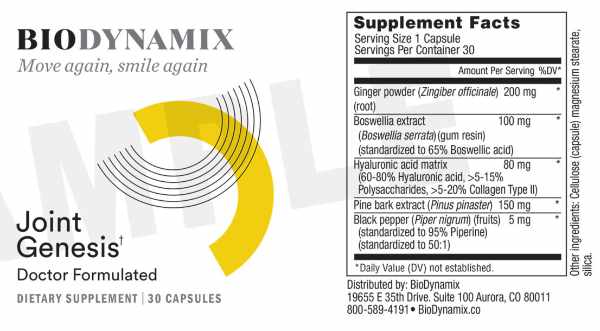
BioDynamix, a nutritional science company specialising in age-related health interventions, recognised the significance of the Mobilee® research and spent several years building a comprehensive formula around it. The goal was not to create a supplement that delivered Mobilee® alone, but to build a complete, synergistic system that addressed every biological dimension of joint deterioration simultaneously.
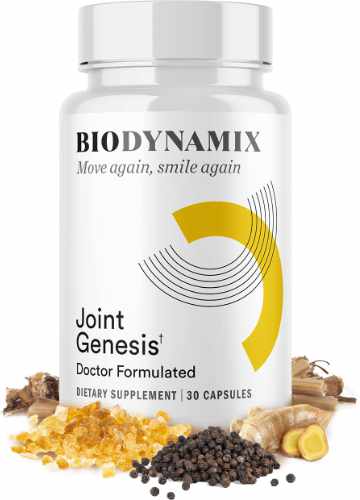
The resulting product — Joint Genesis™ — combines Mobilee® as its foundational ingredient with five additional clinically validated compounds, each chosen for a specific and distinct role in the joint health matrix.
Pycnogenol® — French Maritime Pine Bark Extract (150mg)
Pycnogenol is one of the most extensively studied natural compounds in existence, with over 160 published clinical trials to its name. In the context of joint health, its primary mechanism is antioxidant protection — neutralising the free radicals generated by chronic inflammation that cause ongoing damage to cartilage tissue. A landmark trial published in Phytotherapy Research found that patients with osteoarthritis supplementing with Pycnogenol showed a 55% reduction in pain scores, compared to 26% in the placebo group. A separate study found significant reductions in the use of pain medication among Pycnogenol users over a 12-week period.
This is not a marginal effect. A 55% reduction in pain scores represents a clinically meaningful improvement for people whose daily lives are shaped by joint discomfort.
Ginger Root Extract (100mg)
Ginger’s anti-inflammatory properties have been documented for millennia, but the modern clinical evidence base is increasingly rigorous. A meta-analysis published in Osteoarthritis and Cartilage, reviewing six independent randomised controlled trials, found that standardised ginger extract significantly reduced pain and disability in patients with knee osteoarthritis — with a safety profile superior to NSAIDs. The active compounds responsible — gingerols and shogaols — inhibit the same inflammatory enzyme pathways targeted by prescription anti-inflammatory drugs, without the gastrointestinal and cardiovascular risks associated with long-term NSAID use.
Boswellia Serrata Extract (100mg)
Derived from the resin of the Boswellia tree, boswellic acids — particularly AKBA (acetyl-11-keto-β-boswellic acid) — represent one of the most research-backed natural anti-inflammatory compounds available. Multiple clinical trials have demonstrated improvements in joint pain, range of motion, and walking distance in patients with osteoarthritis. A key distinguishing feature of Boswellia compared to conventional anti-inflammatories is its mechanism of action: it inhibits the 5-LOX enzyme pathway, which is associated specifically with joint tissue breakdown, without the COX pathway suppression that makes NSAIDs problematic for cardiovascular health.
Type II Collagen (40mg)
Cartilage is primarily composed of Type II collagen — a structural protein distinct from the Type I collagen found in skin and bone. Supplementing with undenatured Type II collagen at low doses activates a process called oral tolerisation, in which the immune system is modulated to reduce its attack on joint tissue — a mechanism particularly relevant for patients with inflammatory joint conditions. Beyond immune modulation, Type II collagen provides the structural raw materials that cartilage requires to maintain its integrity and undergo the limited regeneration of which it is capable.
BioPerine® — Black Pepper Extract (5mg)
Inclusion of BioPerine® at a precise 5mg dose addresses a fundamental challenge in supplement formulation: bioavailability. Even the most clinically validated ingredients are only as effective as the proportion that reaches target tissues. BioPerine has been demonstrated in clinical research to enhance the bioavailability of co-administered compounds by up to 20% — ensuring that Joint Genesis’s formula performs at therapeutic concentrations rather than being partially excreted before it can act.
Vitamin D3 (2,000 IU)
Vitamin D deficiency is endemic among adults over 50 in the United States — estimates suggest that more than 40% of American adults are deficient, with rates significantly higher in older age groups. Vitamin D receptors are expressed in cartilage, synovial tissue, and bone. Research has consistently associated adequate Vitamin D levels with slower rates of cartilage loss, lower rates of joint deterioration, and better overall musculoskeletal outcomes. Its inclusion in Joint Genesis addresses a nutritional deficit that undermines joint health independently of everything else in the formula.
What Makes This Different From Everything Before
The supplement market is not short of joint health products. Walk into any pharmacy or health food store and you will find dozens of options — glucosamine, chondroitin, turmeric, collagen powders, fish oil combinations — each claiming to support joint health in some capacity.
What distinguishes Joint Genesis from this landscape is not marketing positioning. It is the specificity and depth of the clinical evidence behind its formulation.
The GAIT trial — the landmark NIH-funded study of glucosamine and chondroitin — found no statistically significant benefit over placebo for the majority of participants. Turmeric and curcumin, while genuinely anti-inflammatory, address symptoms without targeting the biological root cause. Standard collagen supplements use Type I collagen, which has limited relevance to joint tissue. Fish oil provides omega-3 fatty acids with modest anti-inflammatory effects but no direct mechanism for addressing hyaluronan depletion.
Joint Genesis, by contrast, is built around a single, research-backed insight: that the restoration of synovial fluid hyaluronan is the most proximal intervention available in the biological cascade that leads to joint pain — and that Mobilee® is the only orally bioavailable compound demonstrated to achieve that restoration at scale.
Every other ingredient in the formula addresses a specific downstream consequence of hyaluronan depletion — oxidative damage, inflammation, cartilage structural loss, nutritional deficiency — creating a comprehensive intervention that targets the problem at multiple levels simultaneously.

The Scale of the Clinical Validation
The evidence base behind Joint Genesis’s individual ingredients now encompasses:
- Over 160 published clinical trials on Pycnogenol alone
- Multiple randomised controlled trials demonstrating Mobilee®’s 10-fold hyaluronan increase
- Six independent RCTs confirming ginger extract’s efficacy for knee osteoarthritis
- Numerous peer-reviewed studies on Boswellia Serrata across different joint conditions
- A growing body of evidence on oral tolerisation via Type II collagen
- Extensive research on Vitamin D’s role in cartilage health and joint preservation
This is not a formula assembled from trending wellness ingredients. It is a formula built from one of the most rigorously evidenced ingredient stacks in the joint health category — centred on a mechanism that the broader supplement market has not yet recognised or addressed.
Real-World Confirmation
Beyond the clinical trials, Joint Genesis has now accumulated 13,575 verified customer reviews, carrying a 4.9 out of 5-star rating — a dataset representing one of the largest real-world evidence bases for any single joint supplement currently available.
The consistency of reported outcomes across this dataset mirrors the clinical trial findings: reduced morning stiffness, improved range of motion, the return of physical activities curtailed by pain, and — perhaps most meaningfully — a reduction in dependence on pain medication.
“I’ve been on prescription anti-inflammatories for four years. Within eight weeks of starting Joint Genesis, my rheumatologist reduced my prescription by half. After five months, I’m off them entirely. I want people to understand what that means — four years of daily medication, gone.”
— Helen B., Age 64, Minnesota ⭐⭐⭐⭐⭐
“I was scheduled for hip replacement surgery. My surgeon agreed to give me 90 days to try a non-surgical approach before we proceeded. Joint Genesis was the centrepiece of that 90 days. We postponed the surgery indefinitely. I’m not suggesting it works like this for everyone — but for me, it bought back something I thought I’d permanently lost.”
— Raymond J., Age 71, Arizona ⭐⭐⭐⭐⭐Join 13,000+ People Already Using Joint Genesis — Check Availability & Pricing Today →
“What I notice most is what’s absent. I don’t think about my knees anymore when I’m going about my day. I don’t plan routes around staircases. I don’t time my medication around activities. Pain was so present in my daily life for so long that its absence feels genuinely remarkable.”
— Susan P., Age 59, Virginia ⭐⭐⭐⭐⭐
Joint Genesis is manufactured in an FDA-registered, GMP-certified facility in the United States, with every batch independently third-party tested for purity, potency, and safety. The formula contains no GMOs, no allergens, no artificial fillers, and no proprietary blends — full ingredient transparency at clinical doses.
A Turning Point in Joint Health Research
What the convergence of this evidence represents is something the joint health field has been moving toward for years without quite arriving: a comprehensive, biologically grounded intervention that addresses the root cause of age-related joint decline, not merely its symptoms.
The implications extend beyond any single product. They point toward a fundamental reorientation of how the medical and wellness communities think about joint aging — away from the inevitabilist narrative of “wear and tear” and toward a more sophisticated understanding of joint biology that creates genuine room for intervention.
For the tens of millions of Americans currently managing joint pain with inadequate tools — and for the millions more who will cross the threshold of significant symptoms in the coming decade — this reorientation cannot come quickly enough.
The science is clear. The clinical evidence is substantial. The mechanism is understood. And for the first time, a practical, accessible, daily supplement exists that targets that mechanism directly.
The question is no longer whether this approach works. The question is how many people will learn about it before the damage to their joints becomes irreversible.
Find Out If Joint Genesis Is Right For You — Official Site, 180-Day Guarantee →
This is sponsored content produced in association with BioDynamix. The author may receive affiliate compensation for purchases made through links in this article. Individual results vary and are not guaranteed. These statements have not been evaluated by the Food and Drug Administration. This product is not intended to diagnose, treat, cure, or prevent any disease. Readers should consult a qualified healthcare professional before beginning any new supplement protocol.